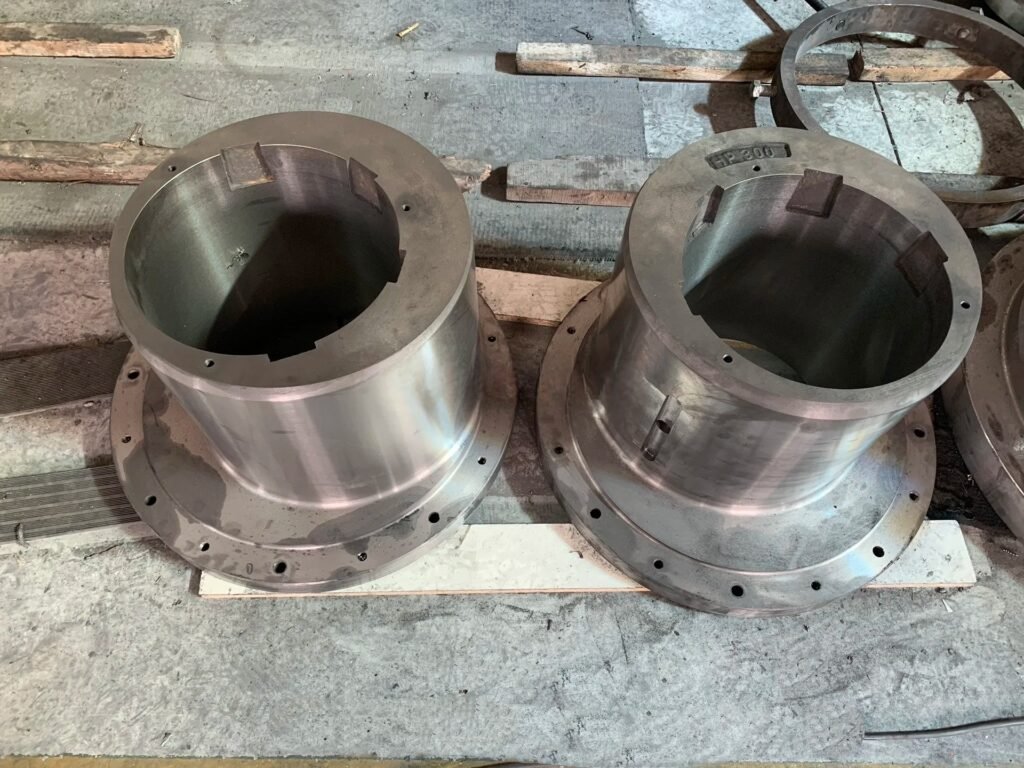
If you’ve worked with cone crushers long enough, you already know this:
eccentric bushings almost never fail on day one.
When they cause trouble, it’s usually weeks or months later — and by then, the cost is no longer limited to the bushing itself.
Below are the issues that repeatedly show up in real operations.
1. Most problems start with clearance that looks acceptable on paper
Clearance values may fall within tolerance, but in operation, the oil film either survives or it doesn’t.
Issues often come from:
Clearance sitting too close to the limit
Minor ovality after machining
Thermal expansion not fully considered under real load
Nothing appears wrong during installation.
The first signs usually appear as temperature rise or unstable lubrication.
2. Surface finish affects lubrication more than most reports suggest
Roughness numbers can meet specifications while surface behavior under load does not.
Typical problems include:
Surfaces too smooth to maintain a stable oil film under shock load
Surfaces too rough, leading to uneven lubrication and early scoring
Once lubrication becomes unstable, wear accelerates across the entire system.
3. Material grade matters less than consistency between batches
Bronze grade is easy to specify.
Batch consistency is harder to control.
Failures are often linked to:
Slight alloy variation
Inconsistent casting density
Uneven hardness through the bushing wall
These issues don’t cause immediate seizure.
They cause predictable early wear that only becomes visible over time.
4. Fitment errors compensate quietly until they can’t anymore
Eccentric bushings don’t announce misalignment.
Problems usually involve:
Bore misalignment
Uneven contact zones
Localized load concentration
By the time vibration increases, the shaft or housing may already be affected.
5. The second service cycle is where weaknesses are exposed
The first run often looks fine.
Problems tend to appear after the second liner change or service interval.
That’s when:
Initial wear alters contact conditions
Marginal clearances disappear
Small deviations start stacking up
This is why repeatability matters more than first-batch performance.
Eccentric bushing failures are rarely caused by a single mistake.
They result from small, controllable deviations accumulating over time.
For experienced buyers, the real question isn’t whether a part is OEM or aftermarket.
It’s whether the next bushing will behave exactly like the last one.